Clikkle Files
Clikkle — December 2023
My Role
Full-stack Developer (UI/UX, Backend, DevOps) — I independently led the entire project lifecycle including UI/UX design, frontend development, backend engineering, database architecture, cloud infrastructure, deployment, and performance optimization
Tech Stack

NextJS

ReactJS

TypeScript

Motion

TanStack Query

Redux

ExpressJS

MongoDB

PostgreSQL

AWS

NodeJS
Timeline & Status
Q4 2023, Launched in January 2024
Overview
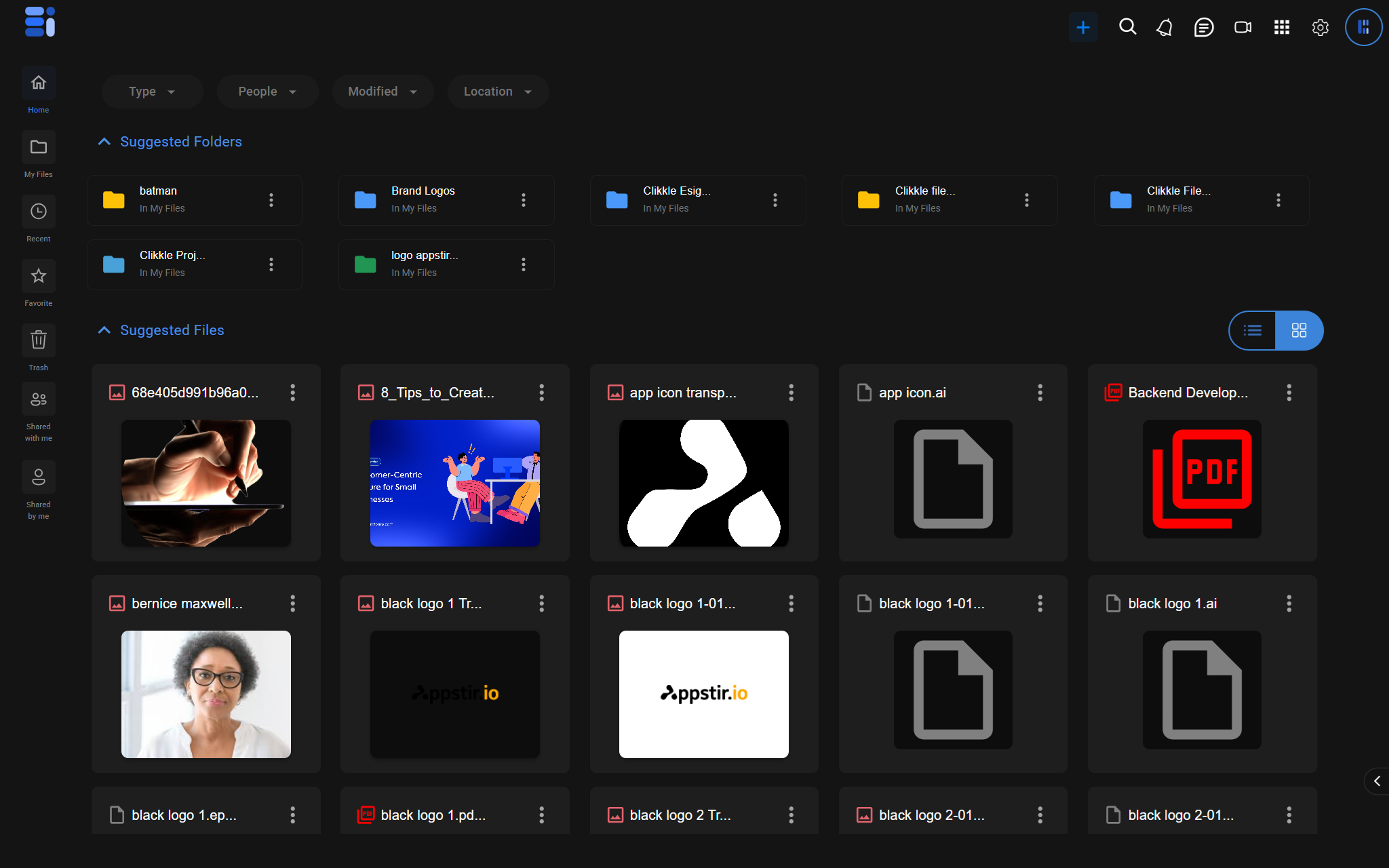
Clikkle Files is a cloud-based file storage and collaboration platform designed for businesses to securely upload, organize, manage, and share files across teams and organizations. The system was built to support large-scale collaboration workflows while maintaining high performance and reliability.
The platform was created for businesses and teams using the Clikkle ecosystem who needed a centralized and scalable solution for file storage, document collaboration, permission management, and secure sharing across multiple products inside the workspace suite.
Highlights
 HIGHLIGHTS
Designed and developed a production-ready file management platform enabling large-scale uploads, secure file sharing, and organization-wide collaboration
Context
Building the backbone of a productivity ecosystem.
The Bigger Picture
Clikkle was expanding its Worksuite ecosystem with productivity and collaboration tools, but there was no centralized infrastructure for handling file storage and document management across products. Teams relied on disconnected systems that created fragmented workflows, duplicated files, inconsistent permissions, and poor collaboration experiences.
Why the Project Existed
The objective was not simply to build a storage application, but to create a foundational product layer that other applications inside the ecosystem could depend on. Similar to how Google Drive integrates with Google Docs, Gmail, and Workspace tools, Clikkle Files was envisioned as the central file infrastructure connecting the ecosystem together.
Product Direction
The platform needed to be scalable from day one, capable of supporting future integrations, organization-level collaboration, increasing storage demands, and high-volume uploads without requiring major architectural rewrites later.
The Problem
This wasn’t going to be your typical file management system.
 THE CHALLENGE
Design a Scalable Cloud Storage Platform Handling Large Uploads, Deep Folder Hierarchies, Complex Permissions, and Enterprise-Scale Collaboration
A Pile-Up of Constraints
Traditional CRUD-based systems quickly became inefficient when nested folder hierarchies, permission inheritance, and large file uploads entered the picture. Uploading files through the backend created unnecessary memory overhead, while deep metadata traversal caused slow query performance and unstable scalability during testing.
Collaboration Complexity
Building organization-wide collaboration introduced challenges around role-based permissions, secure sharing, audit logging, and maintaining consistent access control across folders, files, and shared resources. The system needed to remain secure while still feeling simple and intuitive for end users.
Scalability & Future Growth
The platform could not be optimized only for current requirements. It needed to support future ecosystem integrations, growing datasets, increasing user activity, and large-scale cloud storage demands while maintaining reliability, performance, and maintainability over time.
Goals & Objectives
Designing for Scale, Simplicity, and Long-Term Growth
Build a Scalable Infrastructure
Create a cloud-native architecture capable of handling large file uploads, high-volume traffic, and organization-scale collaboration while remaining modular and easy to extend in the future.
Deliver a Seamless User Experience
Build a file management experience that feels fast, intuitive, and familiar despite the complexity of the underlying backend systems and permission structures.
Create an Ecosystem-Ready Platform
Design the platform in a way that future Clikkle products could integrate seamlessly with the storage system without requiring significant infrastructure changes or duplicated logic.
Key Features
Built for Collaboration, Scale, and Reliability
Cloud File Management
Users could upload, organize, search, move, and manage files using nested folder structures with drag-and-drop interactions, bulk actions, optimized navigation, and metadata-based search capabilities designed for handling large datasets efficiently.
Secure Collaboration System
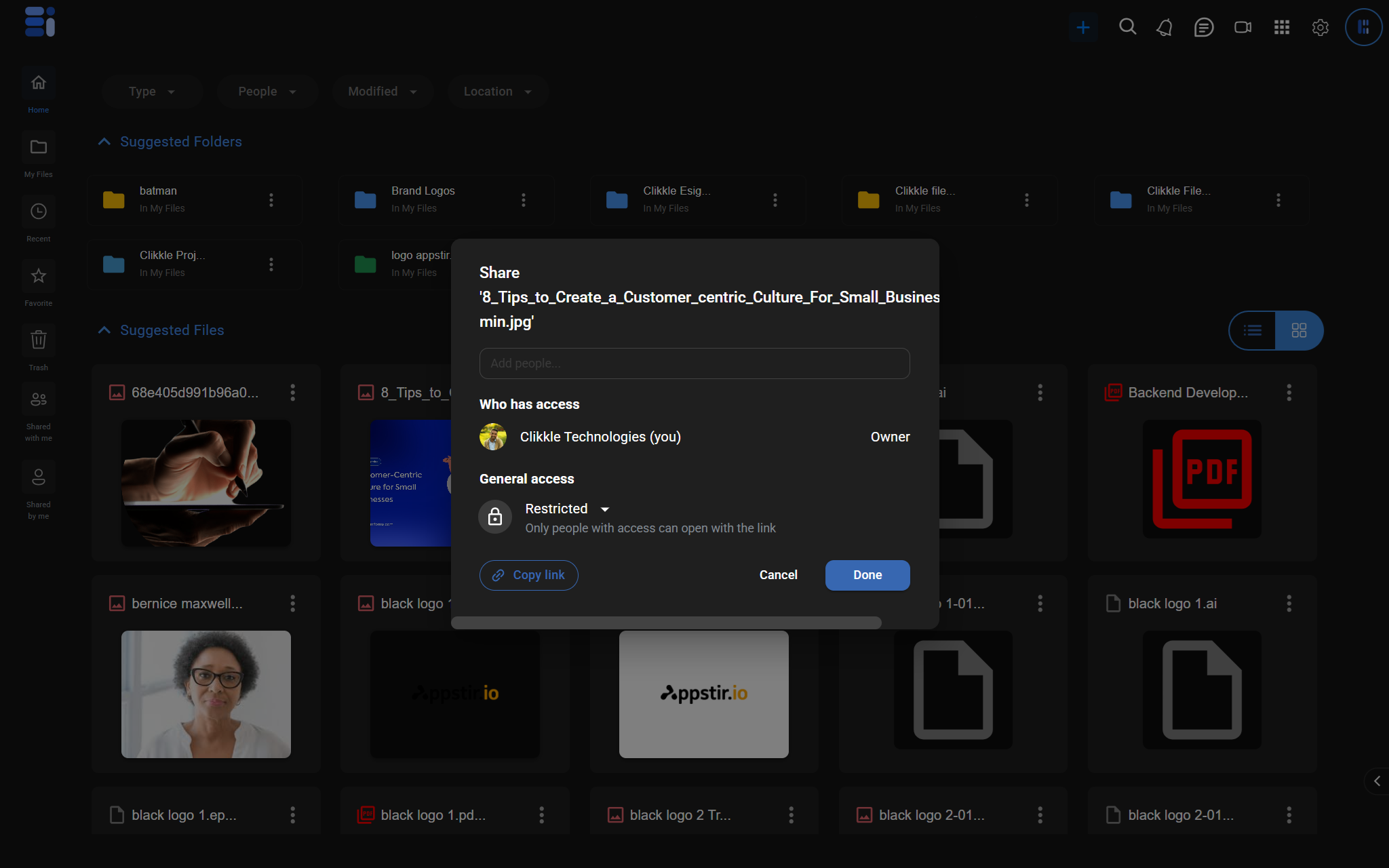
Implemented organization-based collaboration with granular role-based permissions including viewers, editors, and administrators. The platform also supported secure file sharing, version history tracking, and audit logs for improved accountability and transparency.
Performance & Scalability Features
The infrastructure supported direct cloud uploads through AWS S3, intelligent frontend caching, optimized database querying, lazy loading, and scalable APIs designed to maintain responsiveness even during heavy file operations and large-scale usage.
Technical Decisions
Engineering Decisions That Shaped the Platform
Hybrid Database Architecture
PostgreSQL was used for relational consistency around users, organizations, authentication, and permissions, while MongoDB handled flexible file metadata and deeply nested folder structures more efficiently. This hybrid approach balanced scalability, flexibility, and maintainability.
Cloud-Native Upload Strategy
Instead of routing uploads through the backend server, the system generated secure pre-signed AWS S3 URLs allowing files to upload directly to cloud storage. This significantly reduced backend overhead, improved upload stability for large files, and enabled better scalability.
Frontend State & Performance Strategy
TanStack Query handled caching, synchronization, and optimistic updates while Redux managed complex explorer interactions and global application state. Combined with Next.js rendering optimizations, this created a smooth and highly responsive user experience.
Architecture Flow
The Backbone of the Platform
Frontend Layer
Next.js and React powered the user interface, handling file navigation, uploads, caching, optimistic updates, and real-time interaction flows while maintaining a responsive and intuitive experience across the application.
Backend & Storage Layer
Express.js APIs handled authentication, metadata processing, permissions, and business logic orchestration, while AWS S3 managed scalable object storage using secure direct upload flows to minimize backend processing overhead.
Data & System Flow
The client first requested a secure upload URL from the backend, uploaded files directly to AWS S3, and then synchronized metadata into PostgreSQL and MongoDB. This separation improved scalability, reduced latency, and kept the system modular for future integrations.
Challenges
Complex Problems Behind a Simple User Experience
Managing Permission Inheritance
Shared folders and organization-level collaboration introduced complex permission inheritance challenges where nested resources needed to remain secure, consistent, and performant. Middleware-driven access validation and structured permission mapping helped maintain scalability without sacrificing security.
Handling Performance Bottlenecks
Large datasets and metadata-heavy operations initially created slow rendering and retrieval times. Database indexing, optimized queries, frontend caching strategies, and lazy-loading approaches significantly improved application responsiveness during high-volume usage.
Designing for Future Expansion
Since the platform was expected to support future ecosystem integrations, the architecture needed to remain modular and extensible from the beginning. This required careful planning around APIs, storage flow, database structure, and authentication consistency to avoid future technical debt.
Results & Learnings
Building a Scalable Product with Real Business Impact
Performance & Infrastructure Impact
Query optimization, frontend caching, and metadata restructuring reduced file retrieval latency by approximately 45%, while AWS S3 direct uploads lowered backend processing overhead by nearly 60%, resulting in a significantly faster and more scalable platform.
The platform successfully centralized file management workflows inside the Clikkle ecosystem, improved collaboration capabilities, reduced infrastructure bottlenecks, and created a scalable storage layer that future products could integrate with seamlessly.
Personal Learnings & Growth
Leading the project independently strengthened my expertise across frontend engineering, backend architecture, cloud infrastructure, DevOps, database optimization, and system design. The experience reinforced how important scalability, performance, and thoughtful architecture are when building production-grade applications.